

In Morocco, milk thistle (Silybum marianum) goes by three names: شوك الحليب (shawk al-halib) on Arabic labels, شوك الجمل (shawk al-jamal) at the herbalist’s stall, and Chardon-Marie on most French packaging. Its seeds contain silymarin, an antioxidant blend studied for decades for its support of liver cells.
If you have just moved to Casablanca or Rabat, or you grew up here and only ever heard the Darija name, the mix of languages can be confusing. This page sorts out the names, explains what silymarin does according to published reviews, and shows how to take milk thistle capsules properly.
محتوى الصفحة
- 1 What is milk thistle called in Arabic?
- 2 How to recognise milk thistle
- 3 What is silymarin?
- 4 Milk thistle benefits for the liver
- 5 How to take milk thistle
- 6 Common mistakes with milk thistle
- 7 VitalisPro Milk Thistle 300 mg
- 8 Is milk thistle safe? Who should avoid it
- 9 Frequently asked questions
- 9.1 What is milk thistle called in Morocco?
- 9.2 Is شوك الجمل the same as milk thistle?
- 9.3 What are the benefits of milk thistle for the liver?
- 9.4 How many milk thistle capsules should I take a day?
- 9.5 How long should a milk thistle course last?
- 9.6 Does milk thistle tea work as well as capsules?
- 9.7 How much does milk thistle cost in Morocco?
- 10 Read next
- 11 Sources
What is milk thistle called in Arabic?
The standard Arabic name is شوك الحليب, a word-for-word translation of “milk thistle”. Moroccans more often say شوك الجمل, “camel thistle”. Older herbal books also use الخرفيش. All of them point to the same plant when the Latin name on the label reads Silybum marianum.
| Name | Where you will see or hear it | How to say it |
|---|---|---|
| شوك الحليب | Arabic labels and websites | shawk al-halib |
| شوك الجمل | Herbalists, everyday speech in Morocco | shawk al-jamal |
| الخرفيش | Older herbal books | al-kharfish |
| Chardon-Marie | French packaging, the most common in Morocco | shar-don ma-ree |
| Silybum marianum | The scientific name, identical everywhere | si-li-bum ma-ri-a-num |
One warning. “Camel thistle” is a folk name, and in some regions it is also used for other spiny wild plants. If you are buying dried herbs by weight in a souk, there is no label to check. With capsules, there is.
How to recognise milk thistle
Milk thistle is a Mediterranean plant with broad green leaves marked by white veins, spiny edges and purple flower heads. Those white veins, which look like streaks of milk, gave the plant its name. The part used in supplements is the fruit, usually called the seed (Abenavoli et al., 2018).
It grows wild along field edges and rural roads in spring. If you have driven through the countryside around Meknes in April, you have probably passed it without a second look.
Do not confuse it with artichoke, a cousin from the same plant family that is also sold as a supplement. In Arabic, artichoke is الخرشوف. Different plant, different compounds.
What is silymarin?
Silymarin is a mix of plant compounds called flavonolignans, extracted from milk thistle seeds. Its main component is silybin, also called silibinin. When people talk about milk thistle “for the liver”, silymarin is what they mean, and it is what researchers measure in their studies (Bijak, 2017).
The plant has a long record. Reviews trace its use for the liver back more than two thousand years, to Greek physicians and later European herbal medicine (Abenavoli et al., 2010).
Silymarin has one weakness. It dissolves poorly in water and is only partly absorbed from the gut (Abenavoli et al., 2018). So a pot of milk thistle tea brewed at home pulls out very little of it. A capsule with a stated dose in milligrams is the practical choice.
Milk thistle benefits for the liver
Scientific reviews describe three ways silymarin helps the liver: it neutralises free radicals, it helps stabilise the membranes of liver cells, and it supports the liver’s natural ability to build new cells. That is why it is used as a supplement within a healthy lifestyle (Vargas-Mendoza et al., 2014).
The liver filters what you eat and drink and makes the bile that helps digest fat. It rarely hurts. When it is overloaded, what you notice is tiredness that lingers and heavy digestion after a rich meal.
Think of Eid al-Adha. Three days of grilled liver skewers, meat tagines and family lunches that run into dinner. Or the month of Ramadan, with fried briouates and chebakia at every ftour. These are the weeks when supporting your liver makes the most sense.
A 2017 meta-analysis pooled 8 randomised trials with 587 people who had non-alcoholic fatty liver. Liver enzymes (ALT and AST) fell further in the silymarin groups than in the comparison groups (Zhong et al., 2017). A 2020 review of silymarin as supportive care in liver conditions found it generally well tolerated (Gillessen and Schmidt, 2020). Our position is clear: milk thistle is a supplement that helps support liver function. If you are under medical follow-up for your liver, take it alongside that care, never instead of it.
How to take milk thistle
With VitalisPro Milk Thistle 300 mg, take one to three capsules a day with a large glass of water, preferably during meals. Start with one capsule, then adjust within that range. Keep going for several weeks: liver support builds with regular use, not with one big dose. Review how you feel after four weeks.
| Stage | Capsules per day | When |
|---|---|---|
| First week | 1 | With lunch |
| Regular course | 2 | Lunch and dinner |
| Weeks of heavy meals | 3 at most | One with each meal |
During Ramadan, the rule stays the same and only the clock moves: one capsule at ftour, one at suhoor if you take two. Do not swallow it on an empty stomach in the middle of an air-conditioned office day. It belongs with food.
Track three things week by week: how light you feel after eating, how comfortable your digestion is, and your energy in the afternoon.
Common mistakes with milk thistle
Most disappointing courses come from three habits: buying an unlabelled herb, stopping after a few days, and expecting the capsule to cancel out every late fried dinner. Each one is easy to fix, and fixing them is what turns a box of capsules into a course that actually helps your daily comfort.
- Trusting the folk name alone when Silybum marianum is the only reliable check.
- Quitting on day three because “nothing happened”.
- Taking three capsules at once after a wedding feast, then nothing for a week.
- Keeping the 11 pm dinner and the daily fried sandwich.
A desk worker in Casablanca who adds a thirty-minute walk and cuts back on fried food will get far more out of the same box.
VitalisPro Milk Thistle 300 mg
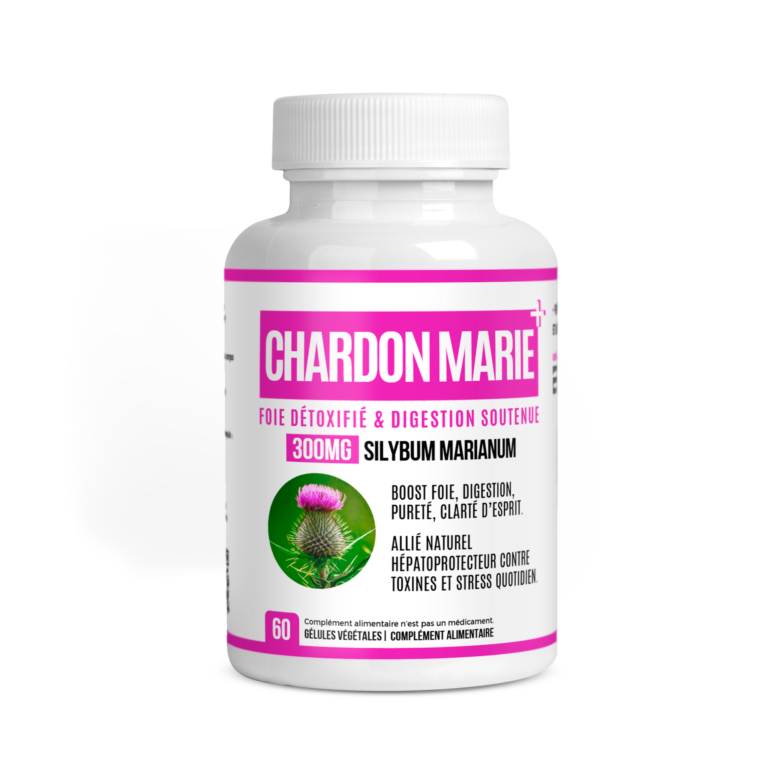
Each capsule of VitalisPro Milk Thistle contains 300 mg of Silybum marianum in a plant-based shell. The Latin name and the dose are printed on the box, so there is no guessing.
What VitalisPro Milk Thistle does for you
- Helps support the natural functions of the liver and its comfort against the pressures of daily life
- Supports healthy digestion and a feeling of lightness after meals
- Supports overall vitality with antioxidants
VitalisPro Milk Thistle 300 mg: 120 DH per box
Cash on delivery · Delivery in 24-48 h anywhere in Morocco · 30 DH shipping with one box, free from two boxes · 14-day money-back guarantee on sealed boxes.
Is milk thistle safe? Who should avoid it
Silymarin is considered safe in humans at usual doses, and the side effects reported are mainly digestive, such as nausea or loose stools (Soleimani et al., 2019). Our milk thistle is not recommended for anyone under 18. If you are pregnant, breastfeeding or on medication, ask a health professional first.
Milk thistle belongs to the daisy family. People allergic to daisies, marigolds or chrysanthemums may react to it as well (NCCIH). The 2019 review notes few drug interactions, with caution for medicines that have a narrow dosing margin.
Frequently asked questions
What is milk thistle called in Morocco?
Usually شوك الجمل (shawk al-jamal) in everyday speech, شوك الحليب (shawk al-halib) on Arabic labels, and Chardon-Marie on French packaging.
Is شوك الجمل the same as milk thistle?
In everyday Moroccan use, yes: both refer to Silybum marianum. Because the folk name is sometimes given to other thistles, check the Latin name on the label.
What are the benefits of milk thistle for the liver?
Its silymarin is an antioxidant that helps protect liver cells and supports their renewal. Users mainly notice lighter digestion after rich meals.
How many milk thistle capsules should I take a day?
For VitalisPro Milk Thistle 300 mg: one to three capsules a day with a large glass of water, preferably during meals.
How long should a milk thistle course last?
Several weeks of regular use. Take stock after four weeks, noting lightness after meals and digestive comfort.
Does milk thistle tea work as well as capsules?
No. Silymarin dissolves poorly in water, so tea extracts only a small part of it. A capsule gives you a known dose.
How much does milk thistle cost in Morocco?
VitalisPro Milk Thistle 300 mg costs 120 DH per box, cash on delivery, with free shipping from two boxes.
Read next
- Dietary supplements in Morocco: 11 common mistakes
- Vitamin B complex for energy and nerves
- Moringa: benefits and uses
- Ashwagandha: benefits and precautions
Sources
- Abenavoli L et al. Milk thistle (Silybum marianum): a concise overview on its chemistry, pharmacological, and nutraceutical uses in liver diseases. Phytotherapy Research, 2018. PMID 30080294
- Bijak M. Silybin, a major bioactive component of milk thistle (Silybum marianum L. Gaernt.): chemistry, bioavailability, and metabolism. Molecules, 2017. PMID 29125572
- Abenavoli L et al. Milk thistle in liver diseases: past, present, future. Phytotherapy Research, 2010. PMID 20564545
- Vargas-Mendoza N et al. Hepatoprotective effect of silymarin. World Journal of Hepatology, 2014. PMID 24672644
- Zhong S et al. The therapeutic effect of silymarin in the treatment of nonalcoholic fatty disease: a meta-analysis (PRISMA) of randomized control trials. Medicine (Baltimore), 2017. PMID 29245314
- Gillessen A, Schmidt HH. Silymarin as supportive treatment in liver diseases: a narrative review. Advances in Therapy, 2020. PMID 32065376
- Soleimani V et al. Safety and toxicity of silymarin, the major constituent of milk thistle extract: an updated review. Phytotherapy Research, 2019. PMID 31069872
- NCCIH (National Institutes of Health). Milk Thistle, accessed 22/11/2026.
Any question before you order? Message us on WhatsApp: 0652 70 17 12.
This information is for general guidance only and does not replace a medical diagnosis. The VitalisPro team does not include health professionals. Please ask a health professional before use, especially if you take medication, or are pregnant or breastfeeding.
