

Vitamin B complex in Morocco: behind a name that sounds technical stands a team of eight vitamins — the one that actually turns your food into real energy and keeps your nerves running smoothly. Here, far from miracle promises, is what science really says about energy, fatigue, nerves and blood — and how to weave this group intelligently into your daily routine with VitalisPro.
You wake up tired, gulp down your coffee in a rush, and by midday the exhaustion returns as if you hadn’t slept at all. Thousands of Moroccans know this feeling every day, and we often blame sleep alone. But before we pin all the blame on short nights, there’s a silent player behind the scenes: the B vitamin group. It’s the team that works in the shadows to turn what you eat into fuel your muscles and brain can use.
In this guide, we take you — in clear language and with reliable sources — on a practical tour: what the eight B vitamins are one by one, how they support energy and focus, what the signs of deficiency are, who is most exposed to it, and how to choose a supplement that suits you in Morocco without getting lost among the names and numbers. We distinguish what is scientifically well established from what falls into exaggeration, because here honesty matters more than the slogan.
Written by Youssef Benjelloun, editorial advisor in natural nutrition · July 2, 2026 · 15-min read
محتوى الصفحة
- 1 Key takeaways
- 2 Why do so many Moroccans feel chronically tired?
- 3 The eight B vitamins: meet each member of the team
- 4 The scientifically supported benefits: what really happens inside?
- 5 B vitamins and the nervous system: the closest relationship
- 6 Methyl or cyano? Understanding the forms of B vitamins
- 7 Dietary sources of vitamin B in Moroccan cuisine
- 8 Who is most exposed to a vitamin B deficiency?
- 9 What distinguishes a good B complex formula?
- 10 Dosage, how to use it and honest precautions
- 11 Reviews and experiences from our customers
- 12 Frequently asked questions about vitamin B complex
- 12.1 What are the benefits of vitamin B complex in brief?
- 12.2 What are the symptoms of a vitamin B deficiency?
- 12.3 When should I take vitamin B complex, morning or evening?
- 12.4 What is the appropriate daily dose?
- 12.5 Is vitamin B complex safe for daily use?
- 12.6 Do vegetarians need vitamin B complex?
- 12.7 Is it suitable for pregnant women or children?
- 12.8 What is the price of vitamin B complex in Morocco and how do I order it?
- 13 Conclusion
Key takeaways
- “Vitamin B complex” is not a single vitamin, but eight water-soluble vitamins (B1, B2, B3, B5, B6, B7, B9, B12) that act as one team, not as separate individuals.
- Their most prominent role is to contribute to normal energy metabolism, to the normal functioning of the nervous system, and to the reduction of fatigue and tiredness — health claims approved by the European Food Safety Authority (EFSA).
- Because the body does not store most of them, it needs a regular daily supply from food or, when needed, from a balanced supplement — not a catch-up dose at the end of the week.
- Some groups are more exposed to deficiency: vegetarians (B12 in particular), older adults, pregnant women, athletes, and those with a low-variety diet.
- VitalisPro offers a complete B complex formula in a single daily capsule, with clear, standards-compliant dosages, with delivery within Morocco and cash on delivery.

Why do so many Moroccans feel chronically tired?
Let’s be honest: the pace of life in cities like Casablanca and Rabat is unforgiving. Long working hours, traffic that swallows an hour or two of your day, meals eaten on the go, and one coffee after another to keep going. All of this creates the perfect ground to drain the body’s reserves of water-soluble vitamins, chief among them the B vitamins.
And here’s the detail many overlook: this group — except for B12 — is not stored long by the body. What you take today is almost entirely used up today, and the surplus leaves in the urine. The result? You need a regular daily supply, not a “catch-up” at the end of the week. And when this supply falters week after week, the body starts sending its signals: exhaustion that sets in during the afternoon, a foggy mind, and a mood that swings for no clear reason.
The reassuring news? When you understand the role of each vitamin separately, the whole thing becomes far simpler than it seems. And for anyone who wants the bigger picture on supplements in the Moroccan market, we’ve prepared a complete guide to food supplements in Morocco that explains when they are genuinely useful and when they are not.
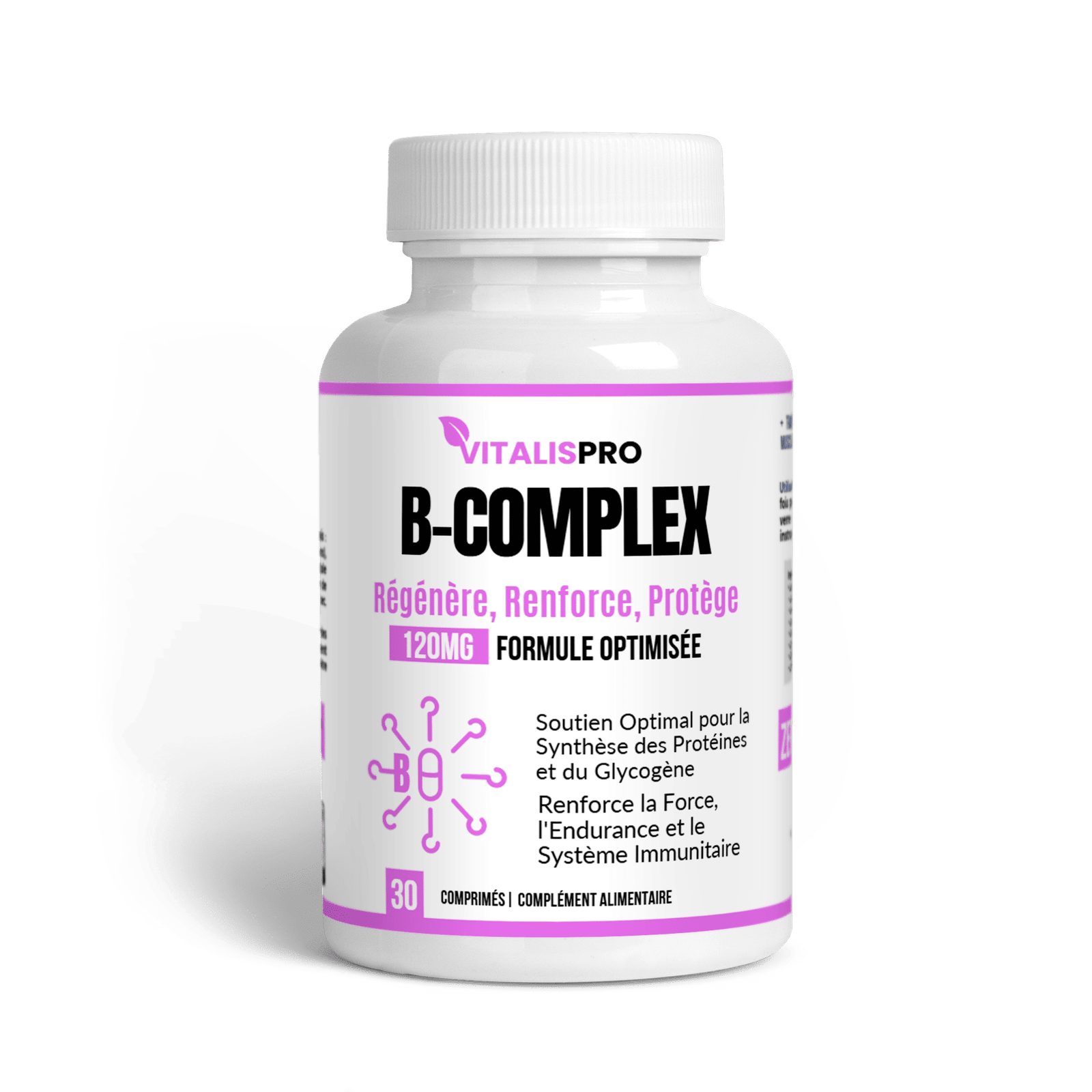
The eight B vitamins: meet each member of the team
Picture a football team of eight players, each in their position, and none wins alone. This is exactly how the B family works: each vitamin most often acts as a “coenzyme” that ignites a specific biological reaction, and many of them stand on the same chain that turns food into energy. Let’s take them now one by one — with the nutrient reference value (NRV) according to European standards, the recognized role, and the main educational signs of deficiency.
B1 — thiamine (NRV: 1.1 mg)
The first of the letters and the most anciently known. It contributes to normal energy metabolism and to the normal functioning of the nervous system, the heart and psychological function. In short, it’s the one that helps your body extract energy from the starches that make up a large part of the Moroccan table: bread, rice, potatoes. Signs that may be associated with its deficiency: general fatigue, loss of appetite and irritability — severe forms are rare today thanks to dietary variety6.
B2 — riboflavin (NRV: 1.4 mg)
A versatile player: it contributes to energy metabolism, to the reduction of fatigue and tiredness, to the protection of cells from oxidative stress, and to the maintenance of normal red blood cells and the health of the skin and vision. A curious detail: it may color the urine a bright yellow after taking the supplement, and this is entirely normal and no cause for concern. Signs that may be associated with its deficiency: cracks at the corners of the mouth, throat inflammation and sensitivity to light7.
B3 — niacin (NRV: 16 mg)
It supports energy metabolism, normal psychological function and the health of the skin and mucous membranes, and contributes to reducing fatigue. Its dose appears in the B complex formula in a balanced amount, far from the very high doses that can cause a temporary flushing of the face. Severe deficiency is rare in varied diets and may appear as exhaustion and skin problems8.
B5 — pantothenic acid (NRV: 6 mg)
Its name derives from a Greek word meaning “from everywhere,” because it is present in many foods. It contributes to normal mental performance, to the reduction of fatigue and to the synthesis of certain hormones and neurotransmitters. That’s why it is rare for anyone to become deficient from diet alone, and when it happens, its signs are very rare, such as fatigue and tingling in exceptional cases9.
B6 — pyridoxine (NRV: 1.4 mg)
One of the family members with the most multiple roles: it contributes to the regulation of hormonal activity, the formation of red blood cells, the metabolism of homocysteine and protein, psychological function and the nervous system, immune support, and the reduction of fatigue. It is also involved in the synthesis of neurotransmitters like serotonin — in other words, it is close to the mood register. Signs that may be associated with its deficiency: mood swings, irritability and sores around the mouth10.
B7 — biotin (NRV: 50 micrograms)
The star of cosmetic products, but it well deserves its place here: it contributes to the metabolism of macronutrients (carbohydrates, fats and protein), to the maintenance of hair, skin and mucous membranes, and to psychological function. Those who care about the health of their hair and nails know this name well. Signs that may be associated with its deficiency: hair loss or weakness, brittle nails, and skin rashes — deficiency is rare but increases with certain conditions11.
B9 — folic acid / folate (NRV: 200 micrograms)
The vitamin talked about at every consultation before and during pregnancy. It contributes to normal blood formation, cell division, the metabolism of homocysteine and amino acids, immune support and the reduction of fatigue, and plays a role in the growth of maternal tissue during pregnancy. This last point holds particular importance, and a pregnant woman or one planning a pregnancy is advised to discuss it with a health professional. Signs that may be associated with its deficiency: fatigue, pallor and a type of anemia known as megaloblastic5.
B12 — cobalamin (NRV: 2.5 micrograms)
The star that preoccupies vegetarians. It contributes to the normal functioning of the nervous system, the formation of red blood cells, the metabolism of energy and homocysteine, psychological function and the reduction of fatigue. Its unique feature is that the body stores it in the liver for months, which is why its deficiency may appear slowly and after a long period. If your first concern is precisely nerves and energy, our dedicated supplement vitamin B12 may interest you. Signs that may be associated with its deficiency: exhaustion, tingling or numbness in the extremities, and a decline in memory and concentration4.
These roles are not marketing phrases, but health claims approved within European Union Regulation 432/2012, based on the assessment of the European Food Safety Authority. The NRV values above are the daily reference values used on the European label.
The scientifically supported benefits: what really happens inside?
Because the members of the B family work on interwoven pathways, their benefits cross and complement each other rather than stand apart. So let’s translate the science into an understandable picture, without misleading simplification or exaggeration.
Turning food into usable energy
Here lies the biggest secret. At least five of the B vitamins — B1, B2, B3, B5, B6 — contribute to “normal energy metabolism.” Picture them as links in a production chain inside the cell’s factory (the mitochondria): each link hands off to the next until what you ate — carbohydrates, fats and protein — turns into a ready-to-use “fuel” called ATP. A detailed scientific review in the journal Nutrients explains precisely how these vitamins act as coenzymes in cellular energy production2. That’s why, when one of these letters is missing, the whole chain stalls, and fatigue reaches you as the final result.
Reducing the feeling of fatigue and tiredness
Six vitamins — B2, B3, B5, B6, B9, B12 — are officially linked to the “contribution to the reduction of fatigue and tiredness” within Regulation 432/20121. Let’s clear up any ambiguity here plainly: this does not mean a “cure for fatigue,” nor a magic energy shot. What is meant is that they support the body’s natural mechanisms when a deficiency in one of these vitamins is part of the root of the problem. If your fatigue is caused by lack of sleep or stress, no supplement will fix it — and honesty here matters more than promises.
Supporting psychological function, mood and memory
B6, B9 and B12 contribute to “normal psychological function” and to the metabolism of homocysteine — an amino acid produced by the body, which these vitamins help keep on its normal path. A comprehensive review titled “B Vitamins and the Brain” discusses the evidence on the relationship between this group and cognitive functions and mood3. And for anyone who wants to go deeper into the axis of memory and mental clarity, the memory and concentration improvement category brings together complementary formulas.
Blood formation and the prevention of a type of anemia
B9 and B12 are two essential players in the formation of red blood cells and cell division. When either is lacking, large immature red blood cells may form that carry oxygen less efficiently — and this is a source of part of the exhaustion and pallor. For those interested in this axis specifically, the Iron + B9 + B12 formula brings together three elements that work together to support energy and blood formation, and you can browse wider options in the anemia support and blood health categories.
B vitamins and the nervous system: the closest relationship
If there is one system that depends on the B family more than any other, it is your nervous system. B1, B6 and B12 in particular contribute to the “normal functioning of the nervous system.” And the picture is deeper than it seems: B12 and B9 take part in the processes that preserve the myelin sheath — that insulating layer around the nerves that lets the signal travel with speed and clarity, exactly like the casing around an electrical wire. And when this layer weakens, the “messages” become slower and less precise.
B6, for its part, is involved in the synthesis of neurotransmitters like serotonin and dopamine, the molecules of mood and motivation. Do you see how everything interweaves? That’s why attention is often paid to the B12 level when feeling tingling, numbness or a decline in concentration, especially among the groups we’ll mention in a moment. The essential message here is simple: nerves don’t ask for a miracle, but for a steady supply of the right letters.
Methyl or cyano? Understanding the forms of B vitamins
Here is a point where many go wrong, and it deserves a minute of your attention. The same vitamin may come in different “forms” on the label, and the two best-known examples are B12 and B9.
| Vitamin | Active form | Classic form | The difference in brief |
|---|---|---|---|
| B12 | Methylcobalamin | Cyanocobalamin | Methyl is a ready-to-use active form; cyano is stable and effective, and the body converts it itself. |
| B9 | Methylfolate (5-MTHF) | Folic acid | Methylfolate is an active form; folic acid goes through a conversion step inside the body. |
What does this mean in practice? Both forms serve their purpose in most people, but the active forms (methylcobalamin and methylfolate) reach the body “ready to use” without an additional conversion step, which may matter to those with lower conversion efficiency. The golden rule when reading: look for a label that states the name of the form, the amount of each vitamin and its percentage of the NRV — transparency is a mark of quality.
Dietary sources of vitamin B in Moroccan cuisine
We won’t tire of repeating it: food first. Variety on the table is your first line of defense, and the supplement comes as support when needed, not as a replacement. And the beautiful thing is that many of these sources are already present in our cuisine.
| Vitamin | Main dietary sources |
|---|---|
| B1 · B3 | Whole grains, legumes (lentils and fava beans), nuts, meats |
| B2 · B7 | Eggs, dairy products, almonds |
| B5 · B6 | Chickpeas, banana, fish, chicken, potatoes |
| B9 (folate) | Spinach and leafy greens, lentils, broccoli, avocado |
| B12 | Meats, fish, eggs, dairy (animal sources essentially) |

Look carefully at the B12 line: its sources are almost entirely animal. This is a pivotal point that explains why vegetarians need special attention to their levels of it, as the vitamin B12 fact sheet published by the U.S. National Institutes of Health (NIH)4 explains, as well as the folic acid (B9) fact sheet from the same source5.
Who is most exposed to a vitamin B deficiency?
Not everyone needs a supplement — let’s say it frankly so as not to sell you an unnecessary worry. But some groups are genuinely more exposed to a drop in reserves, whether because of diet, a stage of life, or reduced absorption. Where do you find yourself?
- Vegetarians and vegans: the first group concerned by B12 in particular, due to its absence from plant sources.
- Older adults: with advancing age, the efficiency of absorbing B12 from food declines, even with sufficient eating.
- Pregnant and breastfeeding women: the need for folic acid (B9) rises at this stage, and it is advised to monitor it with a health professional.
- Athletes and highly active people: higher energy consumption means greater pressure on the B pathways involved in energy production — an axis you’ll find detailed in the energy and sports performance category.
- Those on strict diets or a low-variety diet: whoever eats a single pattern every day misses out on entire categories of nutrients.
- Those taking certain long-term medications: such as some stomach-acid-reducing medications or metformin, which may affect the B12 level over the long term.
As for the question “is it suitable for children?”, the direct answer is: adult supplements are not intended for children, and their needs are estimated according to age and weight, so the decision here belongs to the health professional alone, not to the label. And if you find yourself among the groups above and suffer from persistent exhaustion with no clear explanation, a B complex supplement is a practical option worth discussing.
What distinguishes a good B complex formula?
When you stand before the choices, here are the criteria that make the real difference — and they are the principles on which the VitalisPro formula was built:
- The eight together: because they form a team that acts in harmony, the formula brings the complete family together in a single capsule instead of splitting them apart.
- Balanced and clear dosages: the amount of each vitamin and its percentage of the NRV are stated transparently, without excess or shortfall.
- The simplicity of the daily routine: a single capsule in the morning is enough, with no complication that would make you forget or stop.
- Quality and local delivery: a standards-compliant product, with delivery within Morocco and cash on delivery.

Dosage, how to use it and honest precautions
The general rule for B complex supplements is simple: a single capsule per day, preferably with a meal — breakfast most often — because this improves tolerance, and because the group’s role in energy makes it more suited to the start of the day than before sleep. Always follow the dose stated on the label and do not exceed it, believing that “more is better”; with vitamins, it doesn’t work that way.
And because we believe in honesty before the sale, here are real notes it matters for you to know:
- B2 may give the urine a temporary bright yellow color — an entirely normal sign and not an indicator of danger.
- Some medications interact with B vitamins: for example, B6 at high doses may affect the effectiveness of the medication levodopa, and metformin may lower the B12 level over the long term.
- Folic acid at high doses may mask the signs of a B12 deficiency in blood tests — an additional reason not to overdo it without monitoring.
Consult a qualified health professional before use if you are pregnant or breastfeeding, if you take medications regularly, or if you have a medical condition. The food supplement does not diagnose or treat any disease, and does not replace a varied, balanced diet or a healthy lifestyle.
And if your goal is to support energy and balance on a broader scale, our article on the benefits of magnesium glycinate completes the picture, since magnesium and B vitamins work side by side in many energy pathways. And to browse all the formulas, visit the VitalisPro store or our homepage.
Reviews and experiences from our customers
Real voices are more eloquent than any slogan. Here are three experiences their authors shared with us, with their consent.
With the pressure of work, I felt a heavy drowsiness after lunch, to the point that even coffee no longer worked. After about a month of regularity with the B complex, my day lightened and my concentration came back with me at the office. — Karim, Casablanca
I follow a vegetarian diet and was always worried about a B12 deficiency. With the complete formula, I felt more at ease and more energetic during my day, and I no longer needed to pile up a lot of pills. — Nadia, Rabat
During a busy stretch of work, I was tense and found it hard to concentrate for long. With the morning routine, I felt my nerves calmer and I was able to stay focused longer than before, without that feeling of scattering. — Youssef, Marrakech
These testimonials sum up a single idea: the most solid results come from combining good food, a simple routine, and a regularity that lasts weeks. A question before you start? Our team answers you directly through the contact page.
Frequently asked questions about vitamin B complex
What are the benefits of vitamin B complex in brief?
Vitamin B complex contributes to normal energy metabolism, to the functioning of the nervous system, to the reduction of the feeling of fatigue and tiredness, to the formation of red blood cells and to normal psychological function — in accordance with the health claims approved in European Union Regulation 432/2012. It is a team of eight vitamins that act together, not a single vitamin.
What are the symptoms of a vitamin B deficiency?
They vary by vitamin, but the most common are: persistent exhaustion, cracks at the corners of the mouth (B2), tingling or numbness in the extremities and a decline in concentration (B12), and pallor with a type of anemia (B9 and B12). These are educational signs that do not replace a diagnosis; testing and consulting a health professional remain decisive.
When should I take vitamin B complex, morning or evening?
It is preferable to take it in the morning with breakfast, because its role in supporting energy makes it more suited to the start of the day, and taking it with a meal improves tolerance. Avoid taking it just before sleep.
What is the appropriate daily dose?
The general rule is one capsule per day according to the label. The formula covers the eight vitamins at percentages of the nutrient reference value (NRV), such as 1.1 mg for B1 and 2.5 micrograms for B12. Do not exceed the stated dose: with vitamins, more does not mean better.
Is vitamin B complex safe for daily use?
B vitamins are water-soluble and the body generally eliminates their surplus. Nevertheless, respect the recommended dose, be aware that some medications (such as metformin and levodopa) may interact with them, and consult a health professional if you follow a regular treatment.
Do vegetarians need vitamin B complex?
Vegetarians and vegans are more exposed to a B12 deficiency, since it is found essentially in animal sources; the complete formula is therefore a practical option for them, after consulting a specialist.
Is it suitable for pregnant women or children?
The need for folic acid (B9) rises during pregnancy, but doses for the pregnant woman are determined medically; it must therefore be discussed with a health professional before any supplement. As for adult supplements, they are not intended for children, whose needs are estimated by age and are not decided by the label.
What is the price of vitamin B complex in Morocco and how do I order it?
VitalisPro vitamin B complex is available at the price of 145 DH (instead of 230 DH) with delivery within Morocco and the possibility of cash on delivery. You can order directly from the product page.
Conclusion
Vitamin B complex is not a magic “energy pill,” but a team of eight vitamins that works in silence to turn your food into fuel and keep your nerves, blood and mood on the right track. A varied diet remains the first line of defense, but when it falters — because of lifestyle, a limited diet, or a stage of life — a balanced supplement becomes a practical and honest support. Read the label, respect the dose and hold to regularity: this is how real energy is built, not in a day but over weeks of a quiet habit. This is exactly what VitalisPro’s B complex formula was designed for.
Disclaimer: the information presented in this article is provided for educational purposes only and on the basis of documented research and sources (EFSA, PubMed, NIH and European Union Regulation 432/2012). The VitalisPro team is not composed of health professionals. Vitamin B complex is a food supplement and does not replace a varied, balanced diet or a healthy lifestyle, and is not used to diagnose or treat any disease. It is advised to consult a qualified health professional before use, particularly in the case of an ongoing treatment, pregnancy, breastfeeding or a medical condition.
Sources and references
- European Union Regulation No. 432/2012 on permitted health claims made on foods. EUR-Lex
- Tardy A.-L. et al. — Vitamins and Minerals for Energy, Fatigue and Cognition: A Narrative Review (Nutrients, 2020). PubMed
- Kennedy D.O. — B Vitamins and the Brain: Mechanisms, Dose and Efficacy—A Review (Nutrients, 2016). PubMed
- Vitamin B12 — consumer fact sheet. U.S. National Institutes of Health (NIH ODS)
- Folate (folic acid, B9) — consumer fact sheet. U.S. National Institutes of Health (NIH ODS)
- Thiamin (vitamin B1) — consumer fact sheet. U.S. National Institutes of Health (NIH ODS)
- Riboflavin (vitamin B2) — consumer fact sheet. U.S. National Institutes of Health (NIH ODS)
- Niacin (vitamin B3) — consumer fact sheet. U.S. National Institutes of Health (NIH ODS)
- Pantothenic acid (vitamin B5) — consumer fact sheet. U.S. National Institutes of Health (NIH ODS)
- Vitamin B6 (pyridoxine) — consumer fact sheet. U.S. National Institutes of Health (NIH ODS)
- Biotin (vitamin B7) — consumer fact sheet. U.S. National Institutes of Health (NIH ODS)
